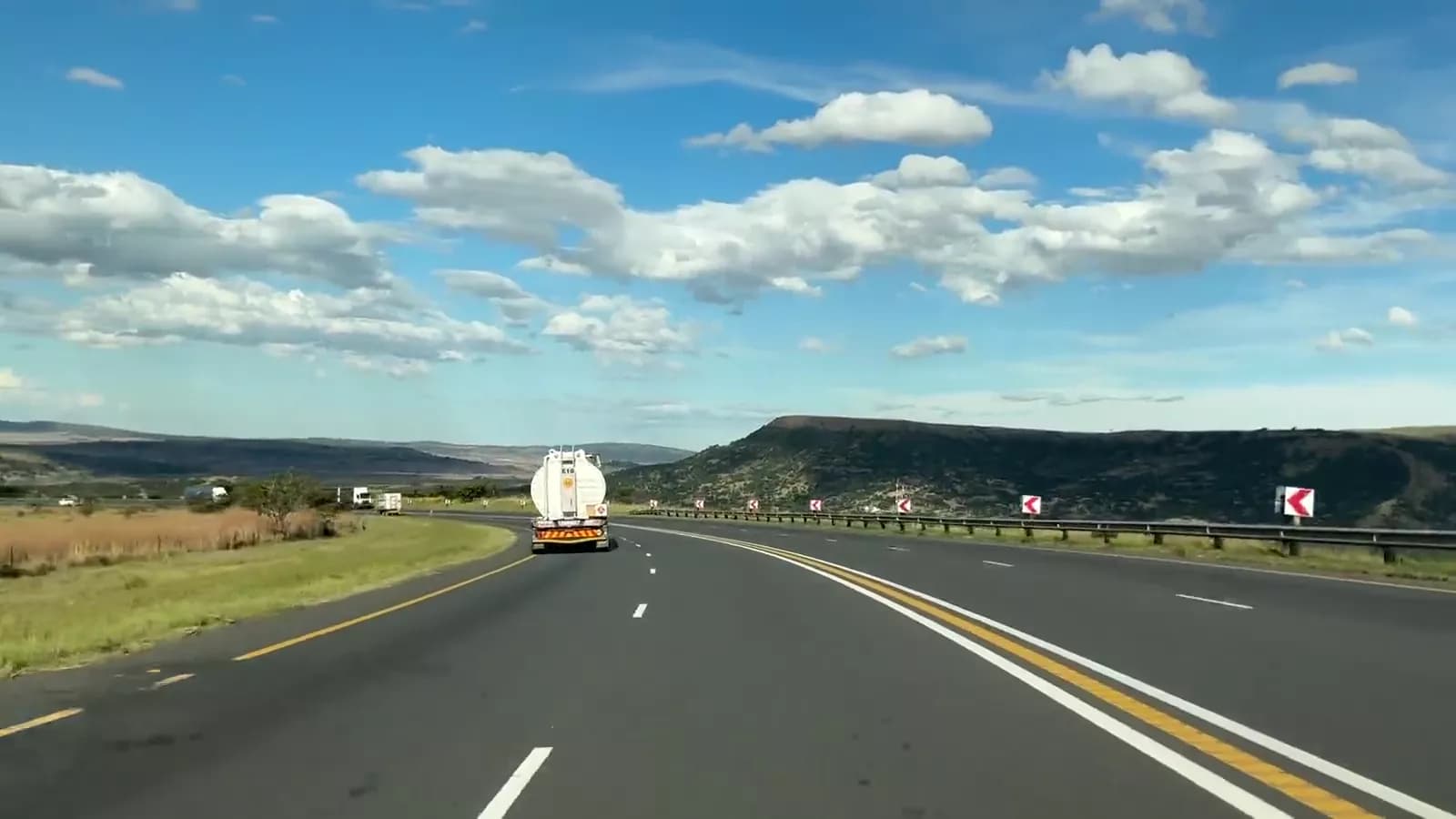
KM 0Monrovia · departure· 06°18′N 10°48′W
Track every vehicle.
Control every liter.
One platform for fleet operations and fuel, built for the roads, networks and currencies of West Africa. Every liter tied to a vehicle, a driver and a place.
KM 1The command centre· Live now
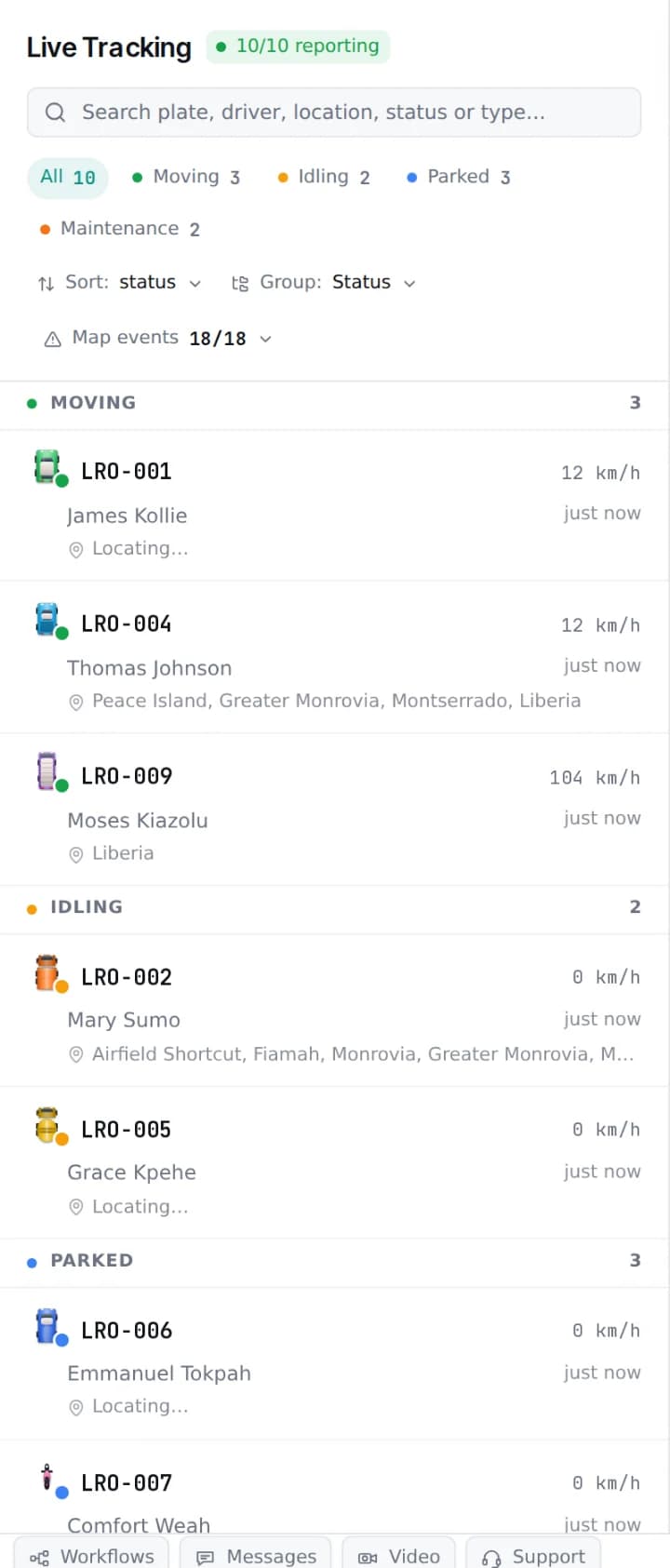
This is the software, running.
A capture of the real thing: ten vehicles reporting into the Monrovia command centre, with status, driver, speed and position, moving as the fleet moves.
Fuel network
Aminata · Petro Trade · Conex · National Petroleum (NP) · independents
Trackers
Teltonika · Concox · Queclink · dual-SIM units
Payment rails
Orange Money · MTN MoMo · Airtel Money · bank transfer · Visa / Mastercard
KM 4Accountability· The record
Ask where the fuel went. The record answers.
Every fuel transaction carries its own evidence: who presented the card, where the vehicle was standing, what the odometer read, and which checks it passed on the way through.
TRANSACTION 4471·0392
Approved- Vehicle
- LR-4471-A · Toyota Land Cruiser
- Driver
- M. Kollie · card PIN verified
- Station
- Aminata Sinkor · AM-SINKOR
- Dispensed
- 48.0 L diesel · LRD 9,600
- Position check
- Matched · 41 m from the pump
- Odometer
- 84,218 km · +118 since last fill
- Time
- 09:41:18 · Africa/Monrovia
The same record is what makes the exceptions visible. Because the platform holds the position, the card, the odometer and the tank together, it can say when they disagree — and it says so on its own, without anyone going looking.
Card presented away from the vehicle
Flagged or declined at the pump, with the distance recorded.
Tank drops while the vehicle is parked
Raised as a siphon alert from the fuel-level stream, not found at month end.
Fifty liters bought, thirty received
The fill is reconciled against the tank reading and the difference is flagged.
Fuelling away from an approved station
Out-of-zone purchase, on the map, with the station it should have been.
Movement after hours
Raised against your own policy window, with the trip attached.
KM 12The platform· One system
Fleet and fuel in one system, because they are one problem.
Register a vehicle once and both sides of the platform know it. The card, the pump transaction and the GPS trail share one database, so there is nothing to reconcile when the month closes.
Live tracking
Second-by-second positions, trip replay, geofences, and remote commands on one map.
Fuel control
Cards, wallets, spending rules, station settlement, and GPS-validated authorization.
Driver safety
A rolling score from real events, with coaching assigned automatically when it drops.
Maintenance
Odometer- and hour-driven schedules, work orders, parts, vendors, and downtime cost.
Reporting
Twenty-one standard reports, a builder without SQL, and scheduled donor-ready PDFs.
Field service
Dispatch by nearest crew, GPS-correlated proof of work, and SLA tracking.
KM 18Peace of mind· The quiet part
You stop wondering where the fleet is.
Where was the pickup at four. Why did the fuel bill jump this month. Did the truck to Ganta arrive. You are answerable for these, and the point of the platform is that you can answer them on the spot, without ringing anybody.
Fitted and watched by us
Our own technicians install the trackers and bind each one to its vehicle by IMEI, and our desk in Monrovia is on the other end when something needs a person.
You find out before you are asked
After-hours movement, a tank falling while a vehicle is parked, a card used away from a station — each one raises itself, with the evidence attached.
A number you can defend
When the auditor, the donor or the board asks, the answer is a report generated from the record, not a figure assembled the night before.
KM 26Command center· The workspace
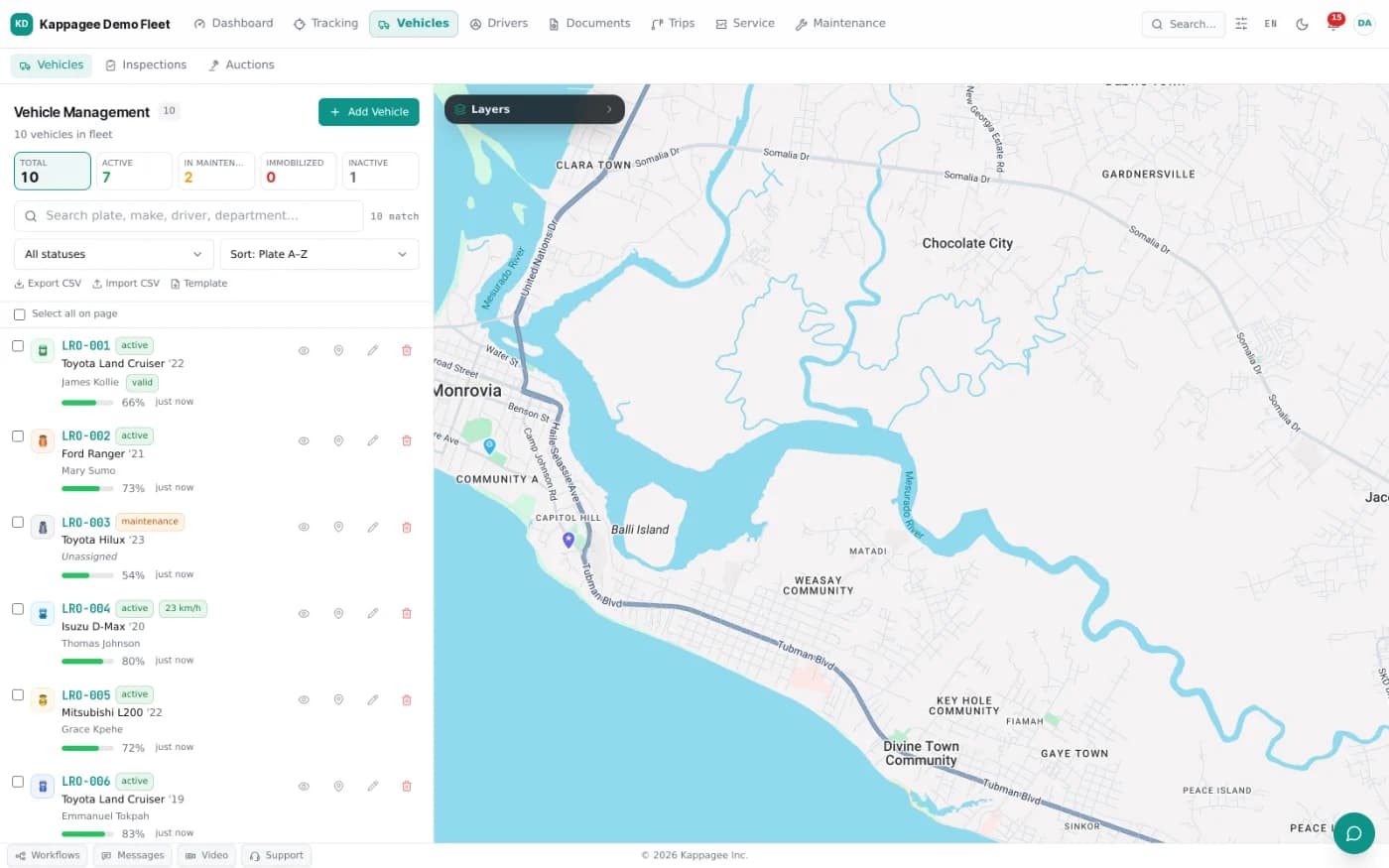
The map is where the work happens.
Operators run the day from it without leaving: track and replay, triage alerts, dispatch a recovery, inspect a fuel purchase, open a camera, immobilise a stolen vehicle. All of it on the same canvas.
Vehicle drawer
Plate, driver, speed, heading, fuel, engine hours, current trip and open work orders — one click from the pin.
Route playback
Any window replayed with speed colouring, stops, idles and overspeed marks, at up to ten times speed.
Geofences
Circles, polygons, multi-polygons and route corridors, with entry, exit, dwell and curfew rules per zone.
Alert triage
The live feed sits beside the map. Acknowledge, snooze, resolve with a note, or escalate on a timer.
Fuel intelligence
Stations and transactions on the map, with fraud indicators drawn where they happened.
Remote commands
Immobilise below 5 km/h with fresh telemetry, on a typed reason, fully audited. Never a surprise to a moving driver.
50,000assets
Rendered on one map
1–3s
Position refresh
<2s
Telemetry, end to end
99.9%
Uptime target
KM 38Fuel control· Authorization
Six checks between a card and a drop of fuel.
Every transaction runs the same sequence, in the same order, in under 200 milliseconds. Any one of the six can end it, and the one that does is written into the record with its reason.
- 01
Card and PIN
Status checked against the live register — a blocked card stops here, on every POS, within seconds of being blocked.
- 02
Balance or credit
Prepaid wallet or credit line, in the account’s own currency. No balance, no dispense.
- 03
Product and volume
Diesel card, diesel pump. Volume checked against the per-fill cap and the vehicle’s tank capacity.
- 04
Position
The vehicle’s last GPS fix is compared with the station. Outside the station’s own 200 m fuelling zone, or on a fix older than five minutes, the transaction is flagged or declined.
- 05
Odometer
The reading the attendant enters must be at or above the last one recorded. A rollback is a flag.
- 06
Pattern
The same card at a second station inside thirty minutes is a flag, whatever the balance says.
MONROVIA → BUCHANAN · 118 KM
LiveSpeed
64km/h
Fuel
92%
Odometer
84,100km
Last fix
09:30:00
CARD 4471 ·· 0392 IDLE — NO TRANSACTION IN PROGRESS
A transaction resolving on the Monrovia–Buchanan corridor
KM 52Built for here· West Africa
Written for Liberia, Sierra Leone and Guinea.
Global platforms assume a fast network, a card rail and one currency. We started from the opposite conditions and built out from there.
It works where the network doesn’t
Trackers buffer tens of thousands of records and forward them when signal returns. The mobile app queues trips, inspections and incidents offline. Timestamps are reconciled to the device clock, so a day recovered from a dead zone lands in the right order.
Mobile Money, wired in properly
Orange Money, MTN and Airtel top up wallets and settle partner stations directly, with idempotent provider callbacks so a retried payment never pays twice.
Four currencies, held properly
LRD, SLL, GNF and USD. Balances are held as whole minor units, never floating point, so a fuel ledger still reconciles to the cent after a year of transactions.
The hardware already on your vehicles
Teltonika, Concox and Queclink through a pluggable adapter layer, including the dual-SIM units common across the region. Bring what you have.
A day on a route with no network
- 09:12
Signal drops
Between Zwedru and Fish Town there is no network. The tracker keeps recording and stores every position on the device.
- 09:12 – 14:40
Work continues
Tens of thousands of records buffer on the tracker. The driver’s app keeps accepting trips, inspections and incidents into its own queue.
- 14:41
Signal returns
The buffer uploads in a single batch. Duplicates are rejected on the device-and-timestamp key, so a retried upload cannot double-count a trip.
- 14:41
The gap is filled in
Records are ordered by the device clock, not arrival time, and written in sequence. Alert rules are then evaluated across the recovered stretch, so a speeding event at 11:20 is still raised.
KM 64Who runs on it· Operators
One platform, every kind of fleet.
From ministry motor pools to mining haulage, in the same system, with the modules, roles and reporting each one actually needs.
Government & ministries
Ministry, agency and county grouping, LRA tax fields, and dedicated-schema or in-country deployment for data sovereignty.
See how it fits
Logistics & distribution
Route adherence, live ETAs and cost per kilometre, with fuel tied to the vehicle that burned it.
See how it fits
NGOs & donor projects
Offline-first field operations and donor-ready reporting per project tag, in the local currency.
See how it fits
Mining & construction
Engine-hour maintenance, geofenced site control and heavy-asset uptime on remote, low-network sites.
See how it fits
Fuel station partners
A back office for the forecourt: transactions, wet stock, shifts, settlement and payouts.
See how it fits
KM 78Operators, in their words· In service
Fleets that stopped reconciling paper against memory.
“Since onboarding with Kappagee Fleet, we have seen significant fuel savings and fewer incidents of damage, misuse and accidents. We can closely monitor and follow the operations of all our vehicles, including those assigned to the Greenville, Harper and Buchanan ports.
 John SiawayDirector of Transport · National Port Authority


KM 102Security & compliance· Trust
Built to survive an audit.
Government and donor-funded fleets have to account for what they spend, sometimes years later. The record is kept so that it still stands up when somebody comes back to check it.
Every query is scoped to the account in the application layer, and again by row-level security in Postgres. A bug in a query still cannot reach across the boundary.
State changes are appended, never rewritten. Fuel transactions are insert-only, in line with PCI-DSS.
Eleven roles from platform admin to driver, MFA for privileged accounts, and time-boxed impersonation that announces itself on screen.
TLS 1.3 in transit, AES-256 at rest, card PANs tokenised and PINs hashed with BCrypt, HSM-ready.
Dedicated-schema isolation for government and regulated clients, and an architecture that supports in-country hosting.
KM 110Before you ask· Questions
Questions we get from transport directors.
No. Kappagee Fleet talks to the dual-SIM trackers already common in the region — Teltonika, Concox and Queclink — through a pluggable adapter layer. Bring your own compatible devices, or we will recommend a supplier.
Fuel is a module inside the platform, not a separate system, so the authorization engine reads the vehicle’s latest position directly. If the vehicle is not inside the station’s own 200 m fuelling zone, or its last fix is older than five minutes, the transaction is flagged or declined before fuel is dispensed.
The tracker buffers and forwards. The POS authorizes against locally cached card rules and syncs later, flagged for review. The mobile app queues trips, incidents and inspections. Nothing is lost, and buffered data is replayed in its original order.
LRD, SLL, GNF and USD, with Mobile Money (Orange, MTN, Airtel), bank transfer and card top-ups. Every balance, receipt and report is shown in the account’s own currency.
Yes. Enterprise and government deployments can run on a dedicated schema, and the architecture supports data-sovereign hosting.
A fleet with trackers already fitted is usually live the same week: bind the devices, import vehicles and drivers, set the policies, issue cards. Fuel-card rollout follows once your station network is agreed.
KM 118Buchanan · arrival· 05°53′N 10°03′W
See it running on your own fleet.
A 30-minute demo on your vehicles, your routes and your fuel spend. We will show you live tracking, a fuel authorization resolving against GPS, and what the platform does when the network drops.